
Sentinel QMSv5 · Ordinal 15 · Reproducibility
Deterministic Post-Export Verification (Public Record)
This page summarises the publicly disclosed reproducibility record and points to the independent artefacts required to reproduce reported results. Ordinal 15 is a pre-registered disclosure integrity test demonstrating deterministic PASS/FAIL outcomes under a hash-only, zero-custody model.
The disclosed record is zero-custody: no raw evidence is published. Verification uses only cryptographic identifiers and public anchoring receipts. PASS indicates cryptographic equivalence to a reference state; FAIL indicates enumerated divergence. Neither implies misconduct or regulatory non-compliance.
Ordinal 15 — Disclosure integrity (primary)
Ordinal 15 evaluates whether a disclosed post-analysis state matches its anchored ground truth using deterministic, hash-only paired comparison. The test is designed to be independently inspectable and does not require access to execution environments or raw evidence.
- Node02: anchored truth (A) vs disclosed state (B) — expected FAIL with explicit enumeration (missing / extras).
- Node03: anchored truth (A) vs disclosed state (B) — expected PASS (cryptographic equivalence).
- Output artefacts are hash-only summaries and deterministic diff lists (no filenames, no paths).
See the Ordinal 15 summary artefacts under Documentation / Guide and the anchoring receipts under Anchors.
Reproduction pathway (public)
- Read the model: Verification Quickstart and the verification model.
- Inspect provenance: cryptographic proofs and anchors are disclosed under Anchors.
- Reproduce reported outputs: follow the instructions in REPRODUCIBILITY.md (GitHub).
For the full datasets and packets used in Stage IV analyses and Ordinal 15, refer to the DOIs listed in REFERENCES. This site intentionally remains a summary and navigation layer.
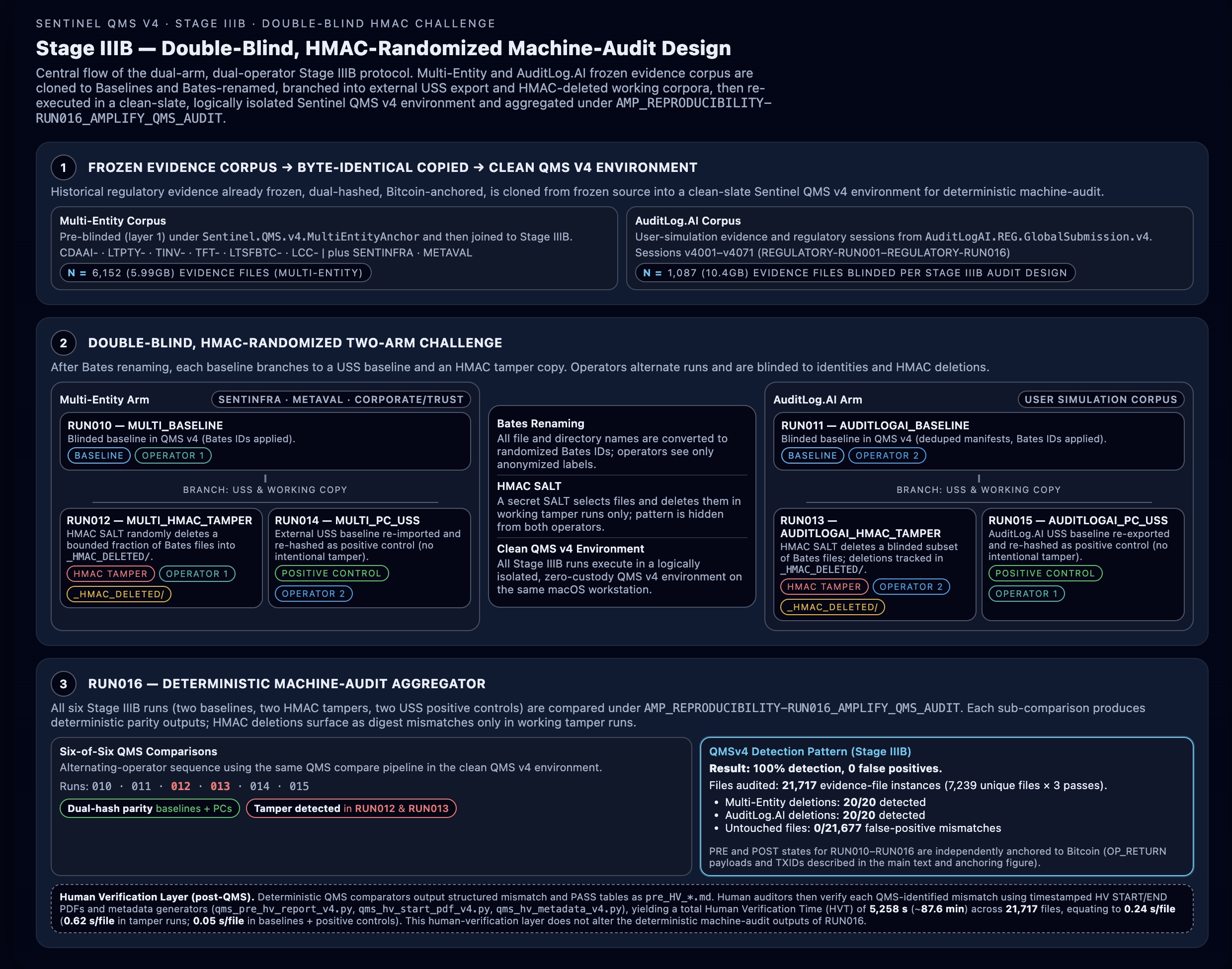
Stage IIIB & Human Verification Time (HVT) — Context
Stage IIIB and HVT measurements are included as historical validation context for the broader programme. The Q2 2026 CRO Audit Trial focuses on post-export verification outcomes and does not require any specific tamper regime.
Stage IIIB used a blinded, HMAC-randomized deletion challenge to generate controlled divergence without exposing filenames or content. The verification model itself does not require challenge generation and applies to routine post-export integrity verification.